What Makes a Racing Game Worth Playing, Even Without a Download
Why do racing games feel so good, and why do we keep pressing restart? A look at the psychology of speed, risk, personal bests and fairness, and what that means for the racers you can play straight from a browser.
Format
Curated Article
Reading Time
8 min read
Published
July 2, 2026
Last Updated
October 20, 2026
Written by
Kaushik Hirpara
Developer · Game Reviewer
Kaushik Hirpara is a full-stack developer and game reviewer at Unihfy Games. He designs and builds every game on the site, gets them playing well on phones, and writes up what players need to know.
View Author ProfileSpeed Is Never Just Speed
Ask someone why they enjoy a racing game and the first answer is usually 'going fast'. But speed on its own gets boring quickly. Hold the accelerator down on an empty straight road and the thrill fades within seconds. What keeps us playing is not the speed itself but what speed forces us to do: decide quickly, commit to a line, judge a gap, and live with the result.
That is why racing games, from big console simulators to small browser racers, share a handful of psychological hooks. They make speed feel dangerous, they put a decision at every corner, they give you someone to beat (often yourself), and, when they are well made, they make you feel that every loss was your own fault rather than the game's.
Understanding those hooks is useful in two ways. As a player, it helps you see why one racer grabs you and another leaves you cold. And if you are choosing a racer to play in a browser, with no download and no big install, it tells you what to look for in a game that has to win you over in the first minute.
The Illusion of Speed
Speed in a game is a trick. Your character or car is not really moving; the world is being redrawn around it. Whether that feels fast depends far less on the number on the speedometer than on what your eyes and ears are told. Things rushing past close to you, a low camera, a road that blurs at the edges and an engine note that climbs all make the same speed feel very different.
Camera position is a good example. A chase camera behind the car shows you the track ahead and makes corners easier to read. A cockpit view narrows what you can see and puts the scenery right next to you, which tends to make the same speed feel more intense. Racers that let you switch views mid-race are a good way to feel the difference for yourself.
Sound does a lot of the work as well. A rising engine pitch tells you that you are gaining speed before you look at any gauge, and a change in tyre noise warns you that grip is going. Good racing games use sound as information, not decoration.
Why Slow Can Feel Fast
How fast a game feels comes from what is close to you and how quickly it passes, not from the speed number. That is why a low camera on a narrow road can feel faster than a high camera on an open highway.
Every Corner Is a Small Gamble
If speed is the fuel of a racing game, corners are its decisions. Every bend asks the same question: how late can you brake? Brake too early and you lose time. Brake too late and you slide wide, lose more time and maybe crash. The best line sits just on the edge of what you can control, and that edge is exactly where the excitement lives.
This is risk and reward in its purest form. Players tend to feel losses more sharply than equal gains, so a corner you overcooked stays in your memory far longer than one you took cleanly. That sting is what makes you want to try the same corner again, a little better this time.
Some racers move part of the gamble off the track. Pit strategy, tyre choice or how much fuel to carry are bets you place before the lights go green, then feel at every bend. They suit a different kind of player: someone who enjoys the slow satisfaction of a plan coming together as much as the quick thrill of a late brake.
Risk You Take in the Moment
- ✓ How late to brake for a corner
- ✓ Whether to squeeze through a gap
- ✓ Whether to drift or grip
- ✓ Felt instantly, through your hands
Risk You Plan in Advance
- ✕ How much fuel to carry
- ✕ How many pit stops to make
- ✕ Which car suits the circuit
- ✕ Felt slowly, lap after lap
The Most Motivating Rival Is Yourself
Beating other drivers is satisfying, but many players spend more time racing someone else entirely: their own best run. A personal best is the perfect opponent. It is exactly as good as you are, it never cheats, and it improves only when you do.
Ghost cars make that rival visible. Instead of a time at the end of a lap, you see a faint copy of your best run moving beside you, and you can see exactly where you are gaining or losing. The race stops being about a number and becomes about a place on the track where you were slower than you could be.
Ghosts also make near misses obvious. Finishing half a second behind your best run, having led it for most of the course, is one of the strongest reasons to press restart. You have just seen proof that a better time is possible, and that you nearly managed it.
"A personal best is the only rival that gets better exactly when you do."
Simple Controls, Deep Skill
It is tempting to think that more controls mean more depth. In practice, some of the most absorbing racers give you very little to press and a lot to think about. When the input is simple, all of your attention goes to timing and judgement, which is where the satisfaction comes from.
Taken to the extreme, a racer can work with a single button. Our balloon racer Loftwind, for instance, has no steering at all: you only rise or sink into winds that blow different ways. The depth comes from timing, not from the number of inputs, and that kind of skill takes a while to learn even though the controls take seconds.
That sort of design lends itself to what psychologists call flow: a state of full absorption that tends to happen when a task is clear, the feedback is immediate and the challenge sits just above your current skill. A racer with simple controls and a clear goal is well placed to get you there quickly.
Losing Feels Fine When It Feels Fair
Nothing makes a player quit faster than a loss that feels cheap. A rival that suddenly gains impossible speed, an obstacle that appears with no time to react, a jump that cannot be cleared: once players suspect the game is against them, the urge to retry disappears.
Fair losses work the opposite way. If you can see what went wrong, such as braking too late or misjudging the wind, the loss turns into a lesson and you want to apply it straight away. That is why good racers spend so much effort on warnings, readable tracks and consistent rules.
Fairness is often invisible when it works. Players rarely notice that a track was tested to make sure every gap can be cleared, or that a hazard is always signposted in time. They only notice when it is missing, which is usually the moment they close the game.
What Makes a Loss Feel Fair or Cheap
Fantasy
Harder always means more fun.
Reality
Difficulty only feels good when you can see why you failed. Hard but readable keeps players; hard and random drives them away.
Fantasy
Rivals should be as fast as possible.
Reality
Rivals feel best when they race by understandable rules, braking for corners and taking a line, so beating them feels earned.
Fantasy
Warnings make a game too easy.
Reality
A warning moves the challenge from guessing to reacting well. You still have to get it right; you just get a fair chance to.
Starting at the Back
Few things in a racing game feel as good as a comeback. Passing car after car gives a steady stream of small wins, each one a clear sign of progress. Leading from the start, by contrast, can feel strangely empty: there is nothing ahead to chase.
That is one reason many racers start you at or near the back of the grid. Every race becomes a climb through the field, and the goal is never abstract: it is always the next car in front.
When Finishing First Is Not the Whole Point
Some of the most interesting racers add a second job to the driving. Having something else to look after splits your attention, and that split is a source of tension in itself: you cannot simply drive the fastest line, because the fastest line might cost you something else.
The second job can take many forms: weapons and items in a kart race, a drift score that matters more than position, a delivery that has to arrive in one piece. In our truck racer Tossload, for example, every bump throws your cargo into the air and you have to catch it again.
Whatever form it takes, the effect is the same. It is still a race, but the question changes from 'how fast can I go?' to 'how fast can I go without losing something else?' That small change is often what makes a racer memorable.
Why Racing Suits the Browser
Racing games have a natural rhythm of short attempts. A course, a race or a run has a clear start and finish, and the restart is only a moment away. That fits the way people often play in a browser: in a spare few minutes, without wanting to install anything first.
The trade-off is that a browser racer has to make its point quickly. There is no long tutorial or opening cinematic to ease you in. The good ones teach their main idea in the first race and then spend the rest of the game making that one idea deeper.
Quick Picks
Try These Ideas Yourself
Our three racers were made in-house at Unihfy Games, and each is built around one of the ideas in this article. All of them run in the browser with nothing to install.

Racing
Loftwind
A one-button balloon race where you steer by rising and sinking into the right wind, with a ghost of your best run.
Racing
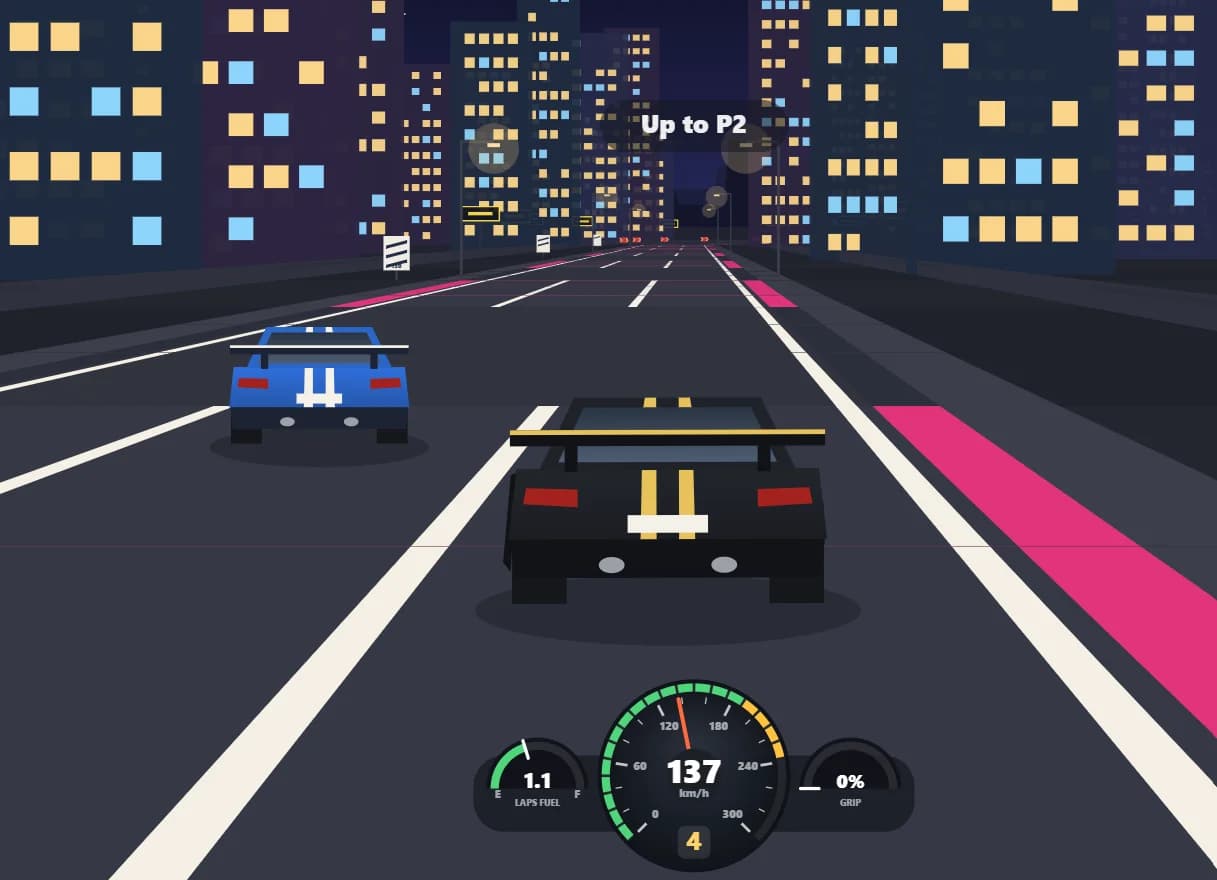
Torque Rush
A car championship where you start last and choose your fuel load and pit stops before every race.

Racing
Tossload
A 3D truck race where every bump tosses your cargo and you steer to catch it before the finish.
Key Takeaway
Racing games hold us through more than speed: the gamble at every corner, a personal best to chase, losses that feel fair, and a clear target just ahead. The next time you press restart, notice which of those is pulling you back.
Related Articles
Gaming
What Makes a Great Arcade Game, and Why It Still Works Online
Arcade games were built to be learned in seconds and to end on purpose. A look at the design ideas behind them, from a single control and a readable screen to rising pressure and risky rewards, and what to look for in a free arcade game online.
Gaming
Why Some Games Help You Unwind, and Others Just Keep You Busy
A relaxing game is not one where nothing happens. A look at why gentle focus rests a tired mind better than doing nothing, how pace, sound, light and predictability shape a calm game, and what to look for when you want to switch off after a long day.
Gaming
What Makes a Good Online Game for Kids, Beyond the Cartoon Art
A game is not good for children because it looks friendly. A look at the design ideas that matter: teaching without text, challenge that fits, mistakes that cost little, visible cause and effect, tension without harm, and the habits that pull the other way.
Gaming
Why Some Games Run Well on Old Laptops, and What Makes Them Feel Smooth
A game that feels good on modest hardware is not just a small game. A look at what a game asks of a computer every frame, why steady and responsive beats sharp and detailed, and how design choices decide whether an old laptop can keep up.
Continue Exploring
Ready For More?
Jump into browser games or challenge yourself in Quiz Arena. There's always something new to discover.